
고양이 악성 췌장 종양
케이스 보기

강아지 고양이의 중성화에 대한 한국의 스탠스는 매우 극단적이죠. 무조건 하는 게 맞다는 쪽과 꼭 해야되는 건 아니다로 보통 극단적으로 갈리는 경우가 대부분입니다만, 실제 강아지 고양이의 중성화 필요성은 매우 미묘한 지점에서 선이 그어지는 경우가 많습니다. 특히 수컷들의 경우는 (유선 종양이나 자궁축농증을 중성화로 예방할 수 있는) 암컷과 달리 꼭 필요한 건 아니지 않냐…는 쪽이 조금 더 우세한 의견입니다. 하지만 이번에 소개할 케이스처럼 고환 종양이 있는 환자들을 보면, 중성화를 했다면 어땠을까 하는 생각이 들기도 하죠. 이번 케이스는 중성화를 하지 않은 수컷에서 문제가 될 수 있는 병들을 여럿 가지고 있는 환자가 오늘동물병원을 찾아서 관련 내용을 살펴볼까 합니다. (수컷에서 중성화를 무조건 해야된다는 얘기는 아닙니다. 그냥 이런 질환이 생기면 그 때는 반드시 중성화를 해야된다의 얘기에 가깝습니다.)
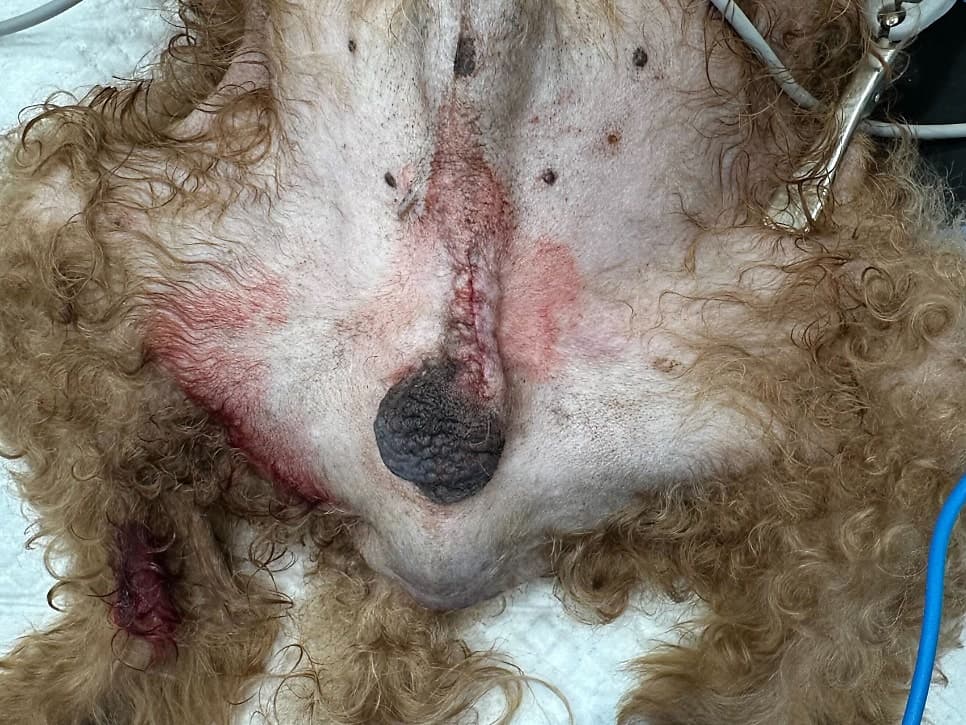
환자는 16살의 중성화를 하지 않은 수컷 푸들로 최근 오늘동물병원이 있는 성수동으로 보호자분이 이사를 오신 경우였습니다. 포스팅의 제목과 달리 고환 종양 때문에 병원을 오신 건 아니고, 항문 주변에 종기같은 게 생겨서 확인을 위해 내원하셨죠. 나이가 있는 노령견이다보니 건강 상태에 대해 이런저런 질문을 보호자분께 여쭤봤는데, 1년 정도 전부터 고환이 많이 부어있었고, 이전에 다니셨던 병원에서도 고환이 부었다는 얘길 들으셨다고 하셨습니다. 어떤 상태였는지 사진을 한 번 보죠.
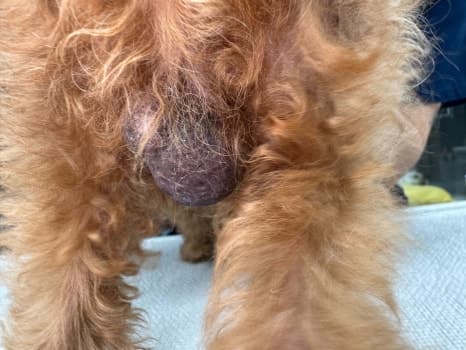
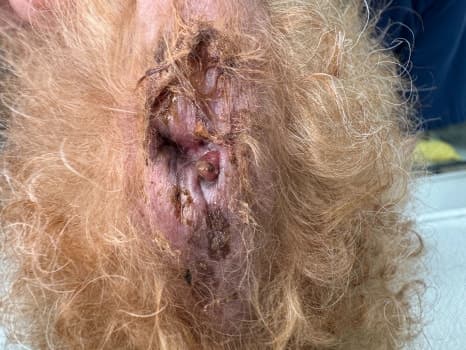
부었다는 고환은 만져보니 아주 딱딱하더군요. 부은 게 아니라 종양이라는 것이 만져만봐도 명확했습니다. 고환 종양 케이스에서 흔하게 보게 되는 잠복 고환은 아니었고, 정상적으로 음낭까지 잘 하강한 고환이었습니다.
고환 종양은 대부분의 경우 기술적으로는 악성 종양이라고 봅니다. 다만 전이가 되는 경우가 드물어서 양성 종양처럼 행동하는 악성 종양이라고 얘기하죠. 1년 정도 별 임상증상 없이 고환 종양을 달고 있었던 게 그럴 수도 있겠거니 할 수 있는 부분이었달까요. 16살이라는 환자의 나이나 보호자분이 갖고 계신 마취에 대한 두려움이 1년 정도 환자가 고환 종양을 달고 그냥 살았던 이유였던 것으로 생각됐습니다. 하지만 가능성이 낮다하더라도 전이가 가능한 “암”이라고 한다면, 그걸 굳이 달고 있어야 할 이유는 딱히 없었고, 보호자분께 수술을 권유드렸습니다. 항문에 있는 것도 종양으로 생각이 됐는데, 보호자분께서 수술을 하신다고 하면, 고환 종양을 수술할 때, 함께 제거해서 조직 검사를 하면 되겠다 싶었죠.
종양이라면 보통 세침 검사(=세포학 검사)를 우선시하는 경우가 많지만, 고환 종양의 경우는 보통 세포학 검사를 잘 하지 않습니다. 고환에 생길 수 있는 종양은 크게 3가지로 Seminoma(정상피종), Leyding Cell Tumor(라이디히 세포 종양), Sertoli Cell Tumor(세르톨리 세포 종양)이 있습니다만, 이 셋 모두 어차피 생기면 고환을 제거하는 중성화 수술을 합니다. 세포학 검사 결과에 상관없이 어차피 떼야 한다면, 그냥 떼고 조금 더 확실한 조직 검사를 하는 게 여러모로 과정을 줄이고 수월한 셈이죠.
보호자분께서 노령견이다 보니 마취에 대한 걱정이 크셨지만, 암일 수 있다는 얘기에 수술을 시켜주시기로 하셨고, 수술 당일 환자를 데리고 내원하셨습니다.
일반적인 동물병원 블로그들을 보면, 케이스 포스팅을 하면서, 마취 전 검사를 (마취 전 검사를 착실하게 잘하는 병원이라는 의미에서) 올려놓곤 하는데, (눈치채신 분이 있으실지 모르지만) 오늘동물병원 블로그에서는 (마취 전 검사를 한 경우에도) 사실 케이스와 크게 관련이 없다고 생각이 되면 마취 전 검사에 대한 얘기를 포스팅에는 잘 쓰지 않습니다. 마취 전 검사가 마취의 안전성을 담보해주지 못하는 경우도 많고, 마취 전 검사가 마취 프로토콜을 바꾸는 경우도 거의 없기 때문인데, 고환 종양은 조금 얘기가 다릅니다. (노령견이라서가 아니라) 고환 종양이기 때문에 마취 전 검사가 필요하죠. 특히 중요한 부분은 환자의 CBC 검사 결과입니다. 이는 고환 종양이 간혹 호르몬을 과도하게 분비하는 경우가 있고, 호르몬 중에서도 특히 에스트로겐을 과도하게 분비하게 되면 에스트로겐에 의한 재생불량성 빈혈(aplastic anemia)를 유발할 수 있기 때문입니다. (이것이야말로 진정한 에겐남…인데, 에겐남은 빈혈이 있을 수 있다는 얘기.)
에스트로겐에 의해 발생한 빈혈은 에스트로겐이 골수에 독성을 보이면서 나타나고, 비가역적인 독성을 보이기 때문에 고환 종양을 수술로 치료해준 이후에도 해결이 되지 않습니다. 빈혈 자체가 환자의 마취 리스크를 높이는 부분도 있지만, 수술 이후에도 예후가 좋지 않을 가능성이 높다는 얘기입니다. 그러니 마취 전 검사에서 빈혈이 있지 않은지(=혹은 골수에 문제가 있지는 않은지) 확인하는 CBC 검사가 필수적이죠.
환자의 CBC 검사 결과는 이렇습니다.
|
검사 항목 |
결과 |
정상 범위 |
|
Hct |
41.1 % |
37.3 – 61.7 |
|
WBC |
▲ 17.12 K/uL |
5.05 – 16.76 |
|
NEU |
11.4 K/uL |
2.95 – 11.64 |
|
LYM |
2.91 K/uL |
1.05 – 5.1 |
|
MONO |
▲ 2.43 K/uL |
0.16 – 1.12 |
|
EOS |
0.33 K /uL |
0.06 – 1.23 |
|
BASO |
0.05 K/uL |
0 – 0.1 |
|
PLT |
476 K/uL |
148 – 484 |
(큰 의미를 갖지는 않는) 단핵구(Monocyte)의 상승 때문에 백혈구(WBC) 수치가 살짝 올라가 있긴 하지만, 빈혈도 없고(=Hct 정상), 혈소판 감소증도 없죠(=PLT 정상). 보통 에스트로겐 과다로 골수에 독성이 나타나는 경우에는 빈혈만 나타나는 게 아니라 백혈구 감소증이나 혈소판 감소증 같은 걸 보게되곤 하는데, 다행히 이 환자는 그런 모습을 보이지는 않았습니다. (이는 난소 종양에서도 동일하게 볼 수 있기 때문에 난소 종양 환자에서도 CBC는 똑같이 중요합니다. 에겐남이든 에겐녀든 강아지에서는 별로 좋지 않다는 얘기)
고환 종양에서 분비되는 에스트로겐은 수컷에서 유선을 발달시키기도 하고, 유선에서 분비물이 나오게 하기도 합니다. 다른 수컷 강아지에게 끌리는 모습을 보이기도 하죠.
고환 종양은 전이가 되는 경우가 그리 많지 않다고는 하지만, 전이 여부는 환자의 예후를 다르게 만들고, 수술 후에 항암 치료를 권하느냐 아니냐를 결정하기도 해서 마취 전 검사로 영상 검사도 하게 됩니다. 환자의 경우도 전이 여부 확인을 위해 영상 검사를 했고, 다행히 영상 검사에서 종양의 전이는 의심되지 않았습니다.
환자는 예정대로 수술을 진행했고, 수술 사진은 이렇습니다. (고환 종양을 제거하기 위한 중성화 수술과 항문 주변의 종양을 제거하는 수술을 함께 진행했습니다.)
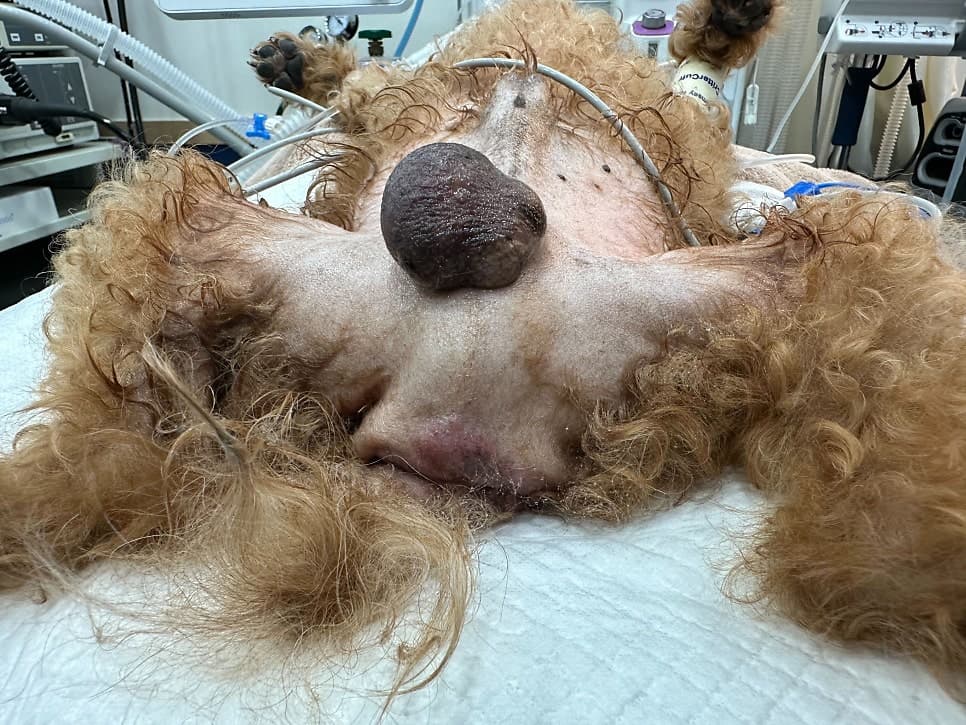
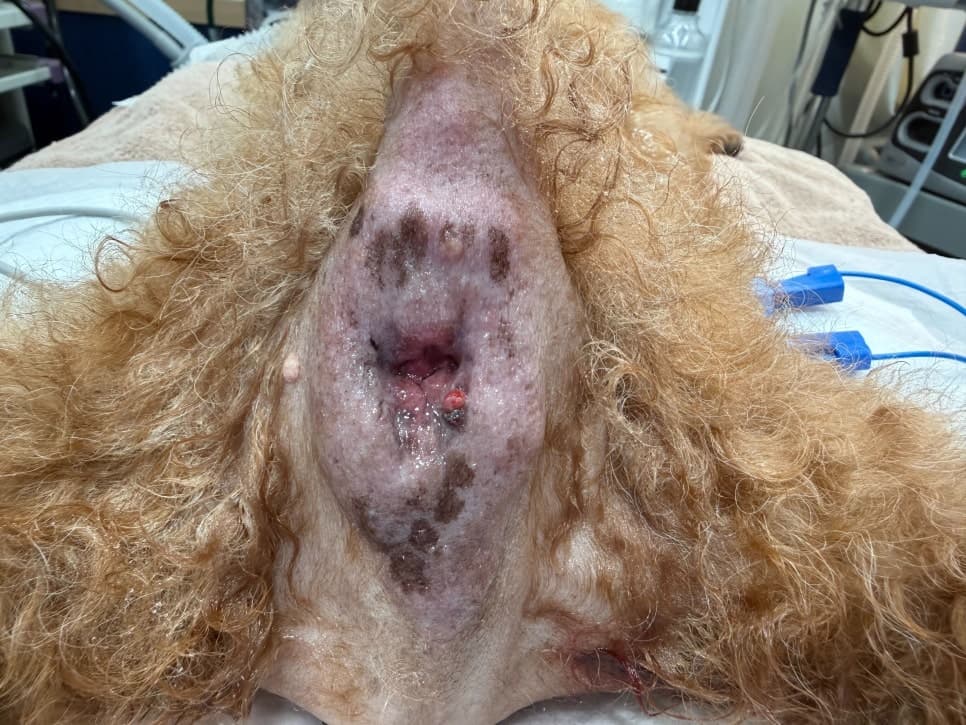
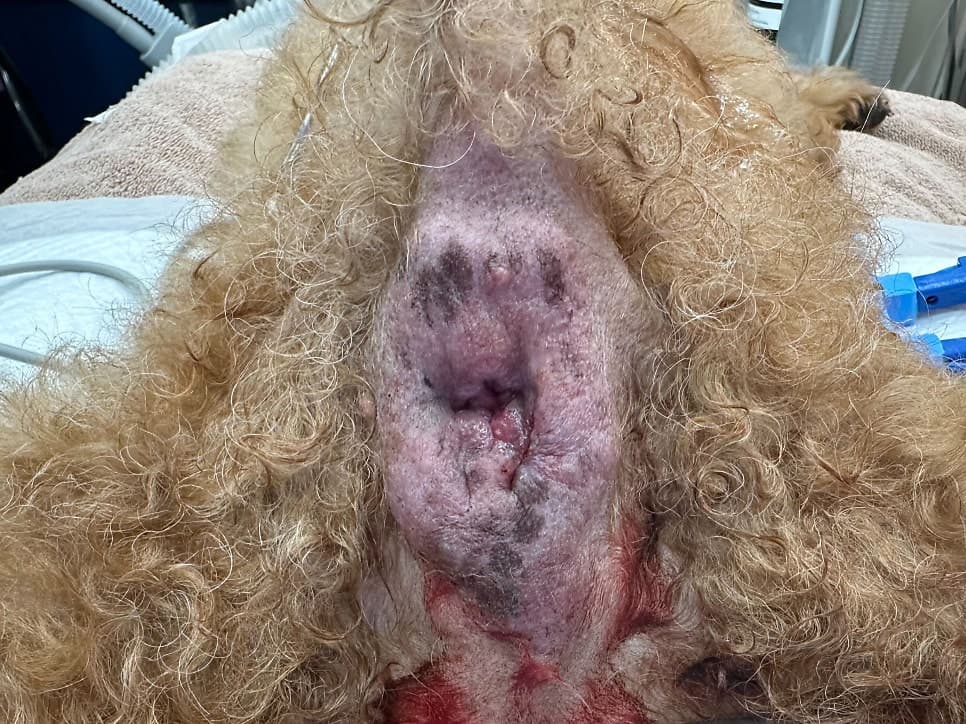
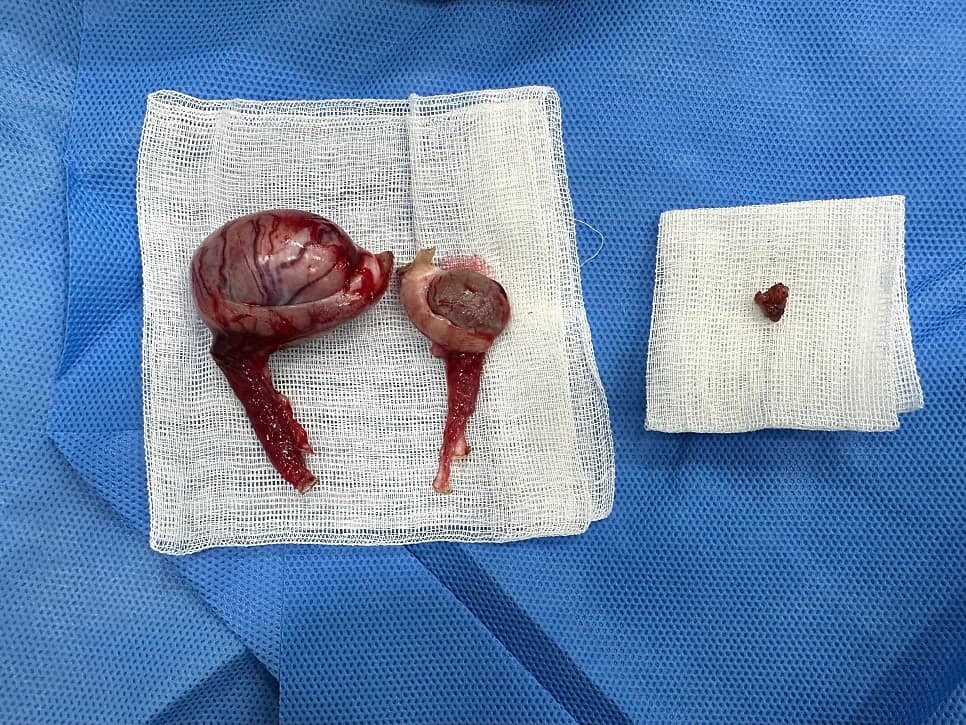
노견이었지만, 마취에서 잘 회복했고, 수술도 어렵지 않게 됐죠. 종양 수술이지만, 기본적으로는 중성화 수술과 수술 방식은 같으니까요. 늘 그런 건 아니라서, 고환만 제거하는 게 아니라 음낭까지 한 번에 제거하게 되는 수술을 하는 경우도 있고, 잠복 고환이라면 개복 수술로 진행이 되는 경우도 있습니다만, 이 케이스는 단순하게 수술을 끝낼 수 있었습니다. 이렇게 수술을 끝내고 나면 제일 중요한 게 조직 검사 결과입니다. 이 환자의 조직 검사 결과는 이렇습니다(조금 깁니다).
INTERPRETATION:
1. Testicle: Mixed germ cell-sex cord stromal tumor
1A. Leydig cell tumor, solid-diffuse
Mitotic count (per 2.37 sq mm): less than one
Histologic tumor-free margins: Clear.
Vascular invasion: Not present.
1B. Seminoma, diffuse
Mitotic count (per 2.37 sq mm): more than 20
Histologic tumor-free margins: Clear.
Vascular invasion: Not present.
2. Perianal: Hepatoid epithelioma (circumanal epithelioma), with peripheral hyperplastic hepatoid lobules
Histologic tumor-free margins: Clear; the nearest peripheral margin is 2.5 mm, with 3.8 mm deep margin.
COMMENTS:
1. 3378’s histologic lesion is most consistent with a mixed germ cell-sex cord stromal tumor.
No invasion of adjacent epididymal and proximal spermatic cord structures were noted.
Mixed germ cell-sex cord stromal tumors include neoplastic cells from both the germ cell (seminoma) and the sex cord stromal (sertoli cell tumor) elements of the testicles, within a single tumor. It has been reported in dogs and stallions, and is considered a collision tumor, rather than a true mixed tumor. These tumors occur more commonly in cryptorchid testicles, and can be unilateral or bilateral. They usually don’t manifest hyperestrinism, and are usually benign (Meuten. 2017. Tumors of Domestic Animals. 5th edition. pp. 713.). In a case series of dogs with mixed germ cell-sex cord stromal tumors, 12 dogs had available follow up information. Of these patients, 8 were alive at the time of follow up with a mean post-surgical survival period of 596 (range = 240-990 days); and, the remaining 4 dogs died of causes unrelated to the neoplasm (Patnaik et al. 1993. Vet Pathol. 30(3):287-295.).
1A. Leydig cell tumors, aka interstitial cell tumors, arise from the steroid producing cells that lie between seminiferous tubules in the testis. It has been reported in dogs, cats, stallions (mostly in cryptorchids), donkeys, bulls, goats and pigs. Unlike in horses, cryptorchidism is not a factor in its development in other domestic species. It can be unilateral or bilateral, and single or multiple.
Although they produce androgens, manifestations of excessive androgen secretions are only rarely noted. These tumors are generally benign, but can cause testicular enlargement and compression necrosis of testicular parenchyma.
Criteria for malignant Leydig cell tumors include more pleomorphic neoplastic cells, more numerous mitotic count, and vascular invasion. Leydig cell tumors can sometimes occur simultaneously with other tumor types in the same testicle. These tumors tend to be benign and do not recur following castration (Meuten (ed.). 2017. Tumors of Domestic Animals. 5th edition. pp. 708-710.).
A recent case series of two malignant Leydig cell tumors in dogs noted metastasis to the skin at the angle of the mouth, dorsal neck, dorsal thorax, and right hind limb. The mitotic counts of the primary tumors were 11 and 21 per 10 high-power fields. Ki-67 expression was also higher than benign Leydig cell tumor (Kudo et al. 2019. JVDI. 31(4):557-561.).
1B. Seminomas are tumors that arise from the germ cell epithelium in the testicle (spermatogenic epithelium of the seminiferous tubules). Seminomas has been reported in dogs, cats, stallions, bulls, rams, and goats. Boxers, Malteses, German Shepherds, and Norwegian Elkhounds have apparent predisposition to this neoplasm. It is usually unilateral but may be bilateral. It may be seen concurrently with other types of testicular neoplasms. Cryptorchidism is a predisposing factor.
There are two subtypes of seminoma based on staining characteristics: classical (PAS+, PLAP+, CD117+) and spermatocytic (PAS-, PLAP-, CD117-). Most canine seminomas are consistent with the spermatocytic subtype, which is considered to be less aggressive with lower angiogenesis rate (Saegusa et al. 2011. Spermatocytic seminoma with neuroectodermal differentiation and sertoli cell tumor in a dog. Vet Pathol. 48(5):1024-1028).
Seminomas are usually benign, and infiltrate within seminiferous tubules, but do not leave the testicle. Malignant forms of seminomas do occur rarely, and can be indicated histologically by infiltration of adjacent structures such as the tunica albuginea, epididymis and spermatic cords. This tumor is confined to the seminiferous tubules in its early form (intratubular seminoma), but in later stages is more diffuse. Metastases (regional nodes, rarely lung and viscera) are found in approximately 6-11% of tumors. Metastasis is more likely in horses than in dogs (Meuten (ed.). 2017. Tumors of Domestic Animals. 5th edition. pp. 710-711.).
2. 3378’s histologic lesion is most consistent with a hepatoid epithelioma.
Perianal gland epithelioma is a low grade neoplasm, arising from perianal glandular tissue (circumanal glands, hepatoid glands), composed primarily of basaloid reserve cells (analogous to sebaceous epithelioma). Perianal epitheliomas (aka hepatoid gland epitheliomas) can be found in the normal locations of hepatoid glands (perianal skin, circumferentially around the proximal third of the tail, flank, dorsal lumbosacral area, lateral to the prepuce, and along the ventral midline as far cranial as the neck and chin). Epitheliomas are clinically similar to the much more common perianal adenomas; however, some authors report that they have a comparatively higher recurrence rate. Metastasis is not reported. Complete excision is curative; although, local recurrence or development of new tumors is common (Gross et al. 2005. Skin Diseases of the Dog and Cat: Clinical and Histopathologic Diagnosis. Second Edition. pp. 658; Goldschmidt et al. 2019. Volume 1: Epithelial Tumors of the Skin. In: Kiupel (ed.). Surgical Pathology of Tumors of Domestic Animals. pp. 132-139; Goldschmidt and Goldschmidt. 2017. Epithelial and Melanocytic Tumors of the Skin. In: Meuten (ed.). Tumors in Domestic Animals. 5th ed. pp. 112-115.).
HISTOPATHOLOGIC DESCRIPTION:
1. There are 2 concurrent neoplasm.
1A. The first one is composed of lobules and nests of polymorphic interstitial cells. Neoplastic cells contain abundant eosinophilic and variably vacuolated cytoplasm with distinct cell borders and central nuclei. Cells are arranged in small sheets and lobules separated by a fine fibrovascular stroma. There is mild anisocytosis and anisokaryosis. There are less than one mitotic figures per ten HPFs. Surrounding testicular parenchyma is compressed by the tumor.
1B. The second one is composed of sheets and nests of pleomorphic, round to polygonal cells within a light fibrovascular stroma. Neoplastic cells contain moderate to abundant eosinophilic cytoplasm and central, vesicular nucleus with 1-4 prominent magenta nucleoli. Neoplastic cells are highly pleomorphic with a high degree of nuclear atypia. Mitotic count is high, with numerous bizarre mitotic figures. Within the neoplasm are numerous individual cell necrosis (starry sky pattern) and lymphocytic infiltrate.
2. A localized dermal mass consists of fairly well-differentiated lobules of perianal glandular epithelium that contain a pronounced basaloid epithelial component. The mass is invested within a light fibrous to fibrovascular stroma. Neoplastic cells are fairly monomorphic and have a low mitotic rate. This unencapsulated mass is expansile, compressing adjacent hyperplastic hepatoid glands. Foci of ulceration, hemorrhage, necrosis and/or granulomatous to mixed inflammation are present in the mass.
PATHOLOGIST:
Rommel M Tan, DVM, MS, PhD
Diplomate, American College of Veterinary Pathologists
IDEXX 조직 검사 결과
꽤 내용이 긴 편인데, 항문 주변의 피부 종양과 고환 모두 조직 검사를 해서 둘 모두에 대한 판독이 들어 있어서 그렇습니다. 먼저 조금 간단한 항문 주변의 종양을 보면, Circumanal epithelioma라는 진단이 나왔습니다. 흔히 항문주위선종이라고 하는 종양이죠. 중성화를 한 강아지에서도 생기지만, 보통은 중성화를 하지 않은 수컷 강아지에서 잘 생기는 양성 종양입니다. 수술만으로 치료가 종료됩니다.
포스팅의 주제인 고환 종양은 재밌는 결과가 보여집니다. Collision tumor(충돌 종양)이라는 걸로 하나의 장기(이 경우엔 고환) 내에 조직학적으로 구분되는 두 종류의 종양이 같이 있었다고 하죠. 고환 하나에 라이디히 세포 종양(Leydig cell tumor)와 정상피종(Seminoma)가 모두 확인된다고 하죠. 그 밑으로는 각각 라이디히 세포 종양과 정상피종에 대한 이러저러한 설명들이 나와있습니다. 정상피종 같은 경우는 잠복고환이 있을 때 발생 가능성이 높아진다는 얘기가 있는데, 이런 리스크 요인들이 수컷 중성화 수술에 있어서 (정상 고환의 경우 수술을 필수라고 보지는 않지만,) 잠복 고환에서 수술을 필수라고 보는 이유가 되죠.
어쨌든 모든 종양이 깔끔하게 잘 제거가 됐고, 수술 부위도 잘 아물었습니다. 이 환자의 경우 (포스팅에 언급하지는 않았지만) 노령의 중성화를 하지 않은 수컷답게 전립선 비대도 있었는데, 중성화를 했으니 아마 이 부분도 시간이 지나면서 좋아지지 않을까 싶네요.
1년 동안 수술을 하지 않고 종양을 달고 살았지만, 전이가 흔하지 않은 고환 종양이었던 덕에 큰 문제 없이 치료가 될 수 있었습니다. 물론 그렇다고 고환 종양을 수술하지 않고 그냥 둬도 괜찮다는 얘기는 아닙니다. 앞서 얘기한 것처럼 에스트로겐을 분비하는 고환 종양이라면 비가역적인 골수 손상을 유발할 수 있고, 이런 경우는 고환 종양 때문에 사망한다는 얘기가 되어버리니 고환 종양이 확인되면 지켜보기보다는 가능한 빨리 수술을 해주는 것이 추천됩니다.